It’s a question every hotel continues to explore – balancing comfort, functionality, and personality in a way that feels effortless to every guest. The lighting is right, the linen is right, and the bathroom feels like something you would see in a magazine. But then a guest asks for a shower chair, and something pulled from a storage cupboard arrives in the room and undoes, quietly but completely, everything that made the space feel considered.
In October 2025, byACRE – the Danish design brand behind some of the world’s most refined mobility solutions – launched DORICA, a universal object built for every guest, every space, and every moment of a stay.
The gap that nobody designed their way out of
Hospitality spends enormous energy on the details that guests notice. The weight of the linen. The temperature of the lighting. The way a bathroom feels at six in the morning. At the same time, truly great experiences also consider the moments when guests may need a little extra physical support. A guest with reduced mobility who needs to sit in the shower. A family with a toddler who needs a step to reach the sink. A guest in their seventies who simply wants to get dressed without having to lower themselves to the floor.
These are not edge cases. They are everyday realities for a large and growing segment of hotel guests. And the objects that have historically existed to meet those needs were designed for hospitals, not hotels.
DORICA was designed for hotels. And for everyone in them.
An object that does not ask to be explained
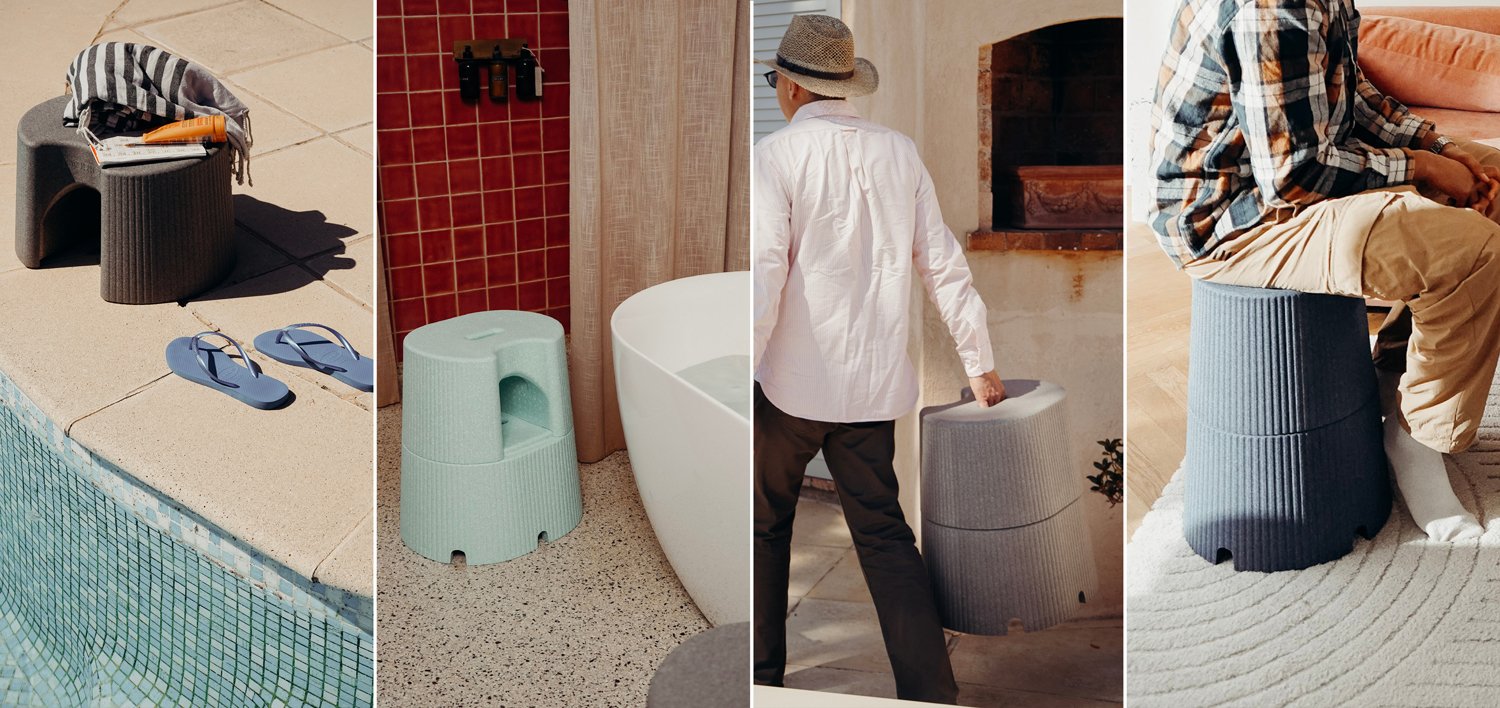
Weighing just 1.9 kg and made entirely from EPP, a material that is water-resistant, bump-proof, chemical-resistant, and fully recyclable, DORICA is a sculptural stool that moves with one hand, sits in a wet shower without pooling water, and holds up to 200 kg without flex.
Two interlocking pieces that offer three height options in a single product, 27 cm, 38 cm, and 50.5 cm, adapting instantly to whoever picks it up and wherever they place it.
It comes in three colourways: Glacier Green, Baltic Blue, and Graphite Grey. Each piece carries its own unique surface composition, shaped during production, meaning no two look exactly alike.
For a design-led property, that is not a detail. That is a conversation starter.
Denise, who lives with MS, described her experience this way: “Super light to move, looks great, perfect for my needs.” What she is describing, without realising it, is the precise quality that hotels have been searching for. Something that works without announcing why it is there.
One object. Every guest. Every space.
The family travelling with a three-year-old does not need to call reception.
But the child uses DORICA as a step at the bathroom sink, a seat at the low table, and a surface to climb onto safely. The design-conscious guest does not experience it as an amenity. They experience it as a piece of furniture that happens to be there, in the right colour, at the right height, in exactly the right place. The guest who needs support in the shower finds it waiting, not folded up in a cupboard, not carried in apologetically, but simply present, as naturally as the towels and the lighting.
Around the pool, housekeeping repositions it in seconds. In the spa, it sits beside treatment areas without the clinical weight of traditional support furniture. On a terrace, it becomes a surface, a footrest, an extra seat for an unexpected guest. Chloe, who was pregnant when she first used one, put it plainly: “I have already used it as a table, a footstool, and a seat around the house and outdoors.”
That instinct, to find new uses without being told what they are, is what every hotel should be offering its guests from the moment they walk through the door.
Design without labels
The most forward-thinking hotels are moving towards a philosophy that byACRE has held from the beginning. That supporting every guest well and designing beautiful spaces are not competing priorities. That the right object, designed with enough care, can do both at once, without drawing attention to either.
DORICA does not require signage. It does not require a dedicated accessibility room. It does not ask a guest to identify a need before their stay. It simply exists in the space, ready for whoever needs it, in whatever way they need it.
That is what it means to design without labels. And it is the kind of thinking that is shaping the future of thoughtful hospitality.
Discover Dorica here